
HOME
By Al Giovetti
Price: $50
Genre: fantasy role playing adventure
Release: September 1997 (was December 1996)
Developer: 7th Level
Lead Artist:
Programmer:
Music Composer: Chuck Mitchell
Licensee: Raymond Feist
Producer: Craig Bolin and Andy Ashcraft
Publisher: 7th Level
Phone: 800-884-8863 extension 501
Website:
www.7thlevel.com
Requirements:Windows 95, DirectDraw, DirectSound, Direct3D




Return to Krondor
History
Raymond E. Feist was born in Southern California and still resides in San Diego. Raymond Feist has written five works on the worlds of Midkemia. Betrayal at Krondor was set during the riftwars which were wars between different fantasy worlds joined by rifts in space and time.
The rifts allowed peoples of each world to slip through and travel in space and time. Some travelers guarded the access to the rifts to take advantage of the adventure of visiting other times and places. Merchants used the rifts to trade new and exotic goods and amass fortunes. And rulers, both evil and benign, used the rifts for conquest, plunder, and alliances, but mostly to do what leaders do, amass more power and wealth.
Ray signed the agreement with 7th level to produce the sequel, now known as Return to Krondor, on November 15, 1994 in Las Vegas Nevada. The game has progressed from their with many watching the developments in a newsletter called the Monthly Midkemian and other sources which occupy the web. When many Return to Krondor and Midkemia in the sequel game, they will not recognize the location since the new game will use all new graphics which go beyond the 1993 Betrayal at Krondor (BAK) graphics and interface.
Almost always the old guard of game reviewers and fans cringe when any
company claims, as 7th level has, that ". . . Return to Krondor By stepping up the action in Return, 7th Level President and CEO George
Grayson, who The Computer Show interviewed recently, is gambling that
the faster action will capture a larger audience than those who might be
alienated by changing the pace they have been used to while playing
these types of games. The award winning turn-based, above and behind
the main characters' perspective combat system seen in the original
Betrayal will be replaced by a "fully controlled 3D combat system and
camera angles for tactical advantage," in Return.
Combat: Mary Crisp, 7th levels Director of Marketing, told us about the combat system as well: "The combat system bears some superficial resemblance to the system used in BAK
since both are 3rd person, turn-based. However, the tactical
options have been enhanced dramatically allowing characters to choose
from three differing attack styles, three types of defense, and over 60
spells. Critical strikes, parting attacks and magic potions are all
supported. Combat also features a unique fate system that adds drama
and an individuality to each battle. There is no grid or hex map
displayed in RK, instead a system of smart cursors will allow the player
to command his characters simply, often with a single click."
Return is divided into nine chapters similar to the original Betrayal at
Krondor, see article on Sierra's upcoming Betrayal at Antarra,
The basic premise of RK center around the mysterious disappearance
of an important artifact of the Ishapian Church, called the Tear of the
Gods. At the center of the intrigue in Return is the retrieval of a
this powerful religious artifact. The Tear of the Gods is lost by the
Ishapian church, while traveling by ship. The priests charge Prince
Arutha with the task of Tear retrieval, and thus the prince and the game
players are drawn into the intrigue.
Mary Crisp, 7th level Communications Manager tells us that ,
"significant portions of the story deal with subjects Feist is only now
revealing in his recent books and touch on the basic nature of reality
within his world of Midkemia. RK takes a more story and art intensive
approach than Betrayal at Krondor and the gameplay, too, will be more
story driven."
3D graphics:
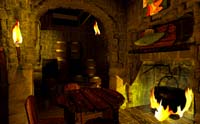
Mary also went on to tell us, "Real-time 3D models are projected over a
pre-rendered 2D backdrop creating a sense of perspective and an unprecedented realism."
Publish your own review or preview, just send us the text by email.
Articles:Company Line
Game Play
Plot
Graphics
Animation
Voice Actors
Music Score
Sound Effects
Utilities
Compare to
Multi-player Features
There are no multiplayer options.
Future Plans:
Conclusion:
We are waiting for this one with great anticipation.
Cheats, Hints, Walkthrough
Journalists
References
Raymond E. Feist Links
Comprehensive list of links:
http://ns.netmcr.com/%7Esrussell/Feist_Resources.html
http://reality.sgi.com/employees/rchiang_esd/Feist.html
K. Brown, Computer Gaming World, number 144, July, 1996, pg. 43
Kevin Perry, www.happypuppy.com/pulse/sneaks/pc/krondor.html
All About Games